These records are found in the online catalog of The Mariners’ Museum and Park in Newport News, Virginia. Uncurated search results are presented to give researchers and interested readers an idea of whether the museum’s archives contain information about this vessel and whether it may be worthwhile to visit the museum’s catalog search page for further investigation. Uncurated results may be inaccurate or incomplete.
Mariners Museum online catalog search, July 12, 2026. Search phrase: "Hobart". Catalog returned 89 records; this selection table includes 89 records fetched through catalog result pages.
Use these buttons to send uncurated search results to your own app or text document for further research. First, check the box for any row, or click "Select All" then uncheck any rows. Then click "Show Selections". You can then copy your selections from the text box and past them into your app.
The Sydney Hobart Yacht Race (sometimes referred to as the 'Bluewater Classic' in the Australian media) is hosted by the Cruising Yacht Club of Australia, starting in Sydney, Australia on Boxing Day and finishing in Hobart. The race distance is approximately 630 nautical miles (1,170 km). The race is run in co-operation with the Royal Yacht Club of Tasmania. The race was initially planned to be a cruise by Peter Luke and some friends who had formed a club for those who enjoyed cruising as opposed to racing, however when a visiting British Royal Navy Officer, Captain John Illingworth, suggested it be made a race, the legendary event was born. The Sydney to Hobart Yacht Race has grown over the decades, since the inaugural race in 1945, to become one of the pre-eminent offshore yacht races in the world and it now attracts maxi yachts from North America and Europe. The 2004 race marked the 60th running of the event. The current race record was set in 2005 by Wild Oats XI, which crossed the line in a time of 1 day, 18 hours, 40 minutes and 10 seconds.[1]. The longest surviving skipper from the inaugural race, Peter Luke, who contributed to the formation of the Cruising Yacht Club of Australia and the establishment of the Sydney to Hobart Yacht Race, passed away on 23 September 2007 aged 92, the last of the original sailors who pioneered this magnificent event.
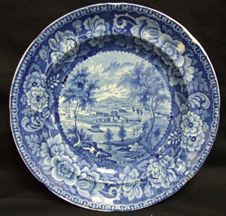
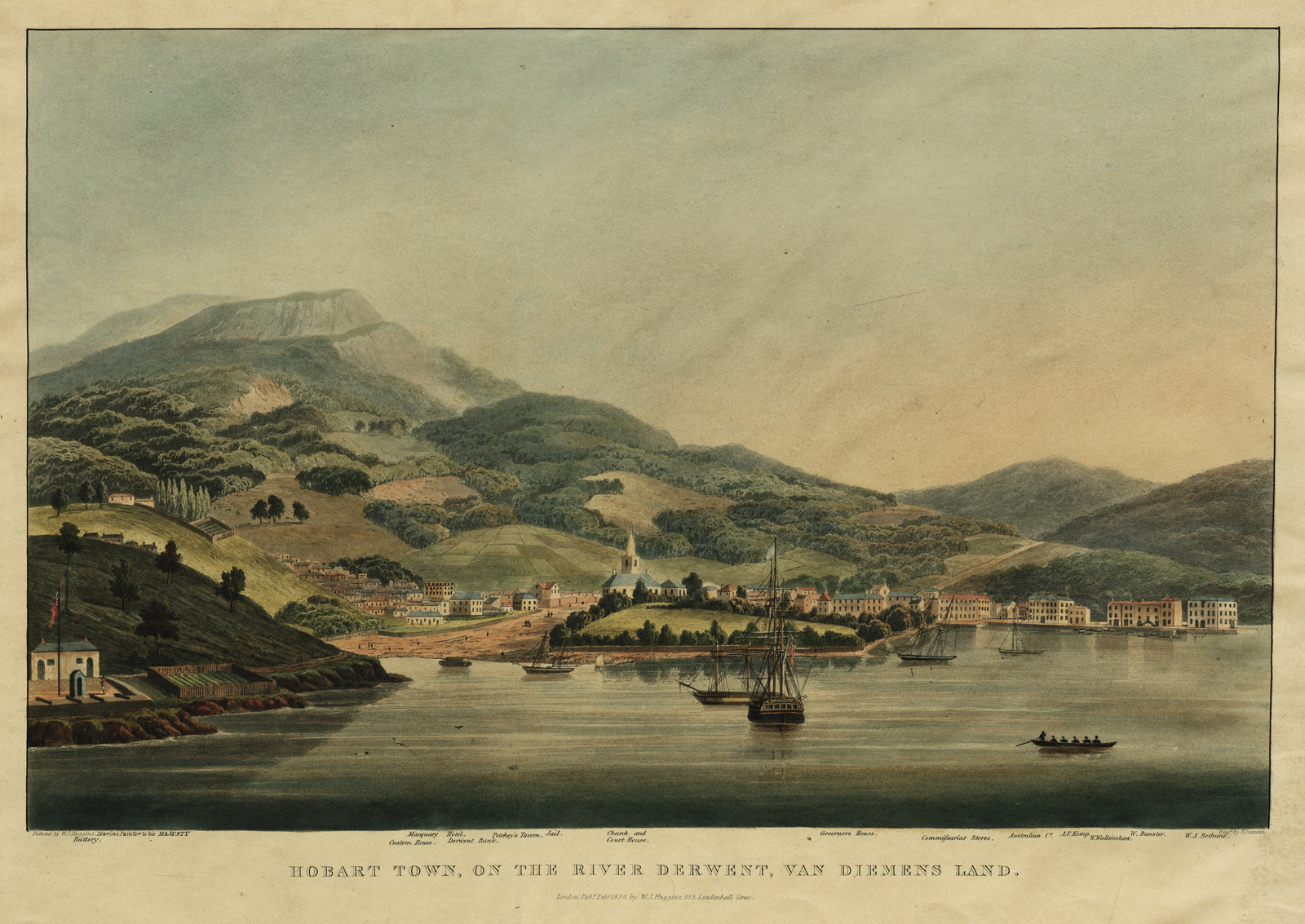
SHORT DESCRIPTION: Light blue staffordshire plate with flower boarder and an inscription on the back. NOTES: Considered to be a view of the little town of Hobart on the Delaware River near its source in New York State.
ENGLAND, LONDON, GREAT GEORGE STREET, WESTMINISTER
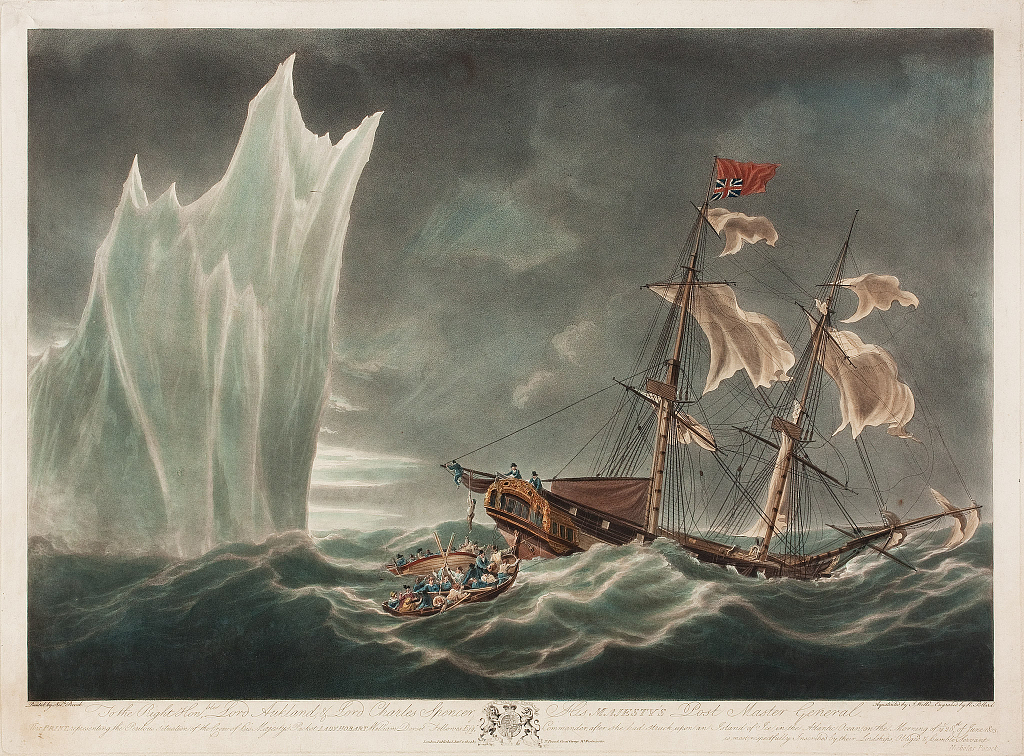
ADDITIONAL INFORMATION: See "Chronicles of the Sea", p. 129-135. See "Hazards of the Deep" by Captain Stanley Rogers. LABEL COPY: PERILOUS SITUATION OF THE CREW OF HIS MAJESTY'S PACKET LADY HOBART...AFTER SHE HAD STRUCK UPON AN ISLAND OF ICE IN THE ATLANTIC OCEAN, 1804 After Nicholas Pocock (English, 1741-1821) Engraved by Robert Pollard (English, 1755-1838) Aquatinted by John Wells (English, active 1792-1809) Published by N. Pocock Shortly after taking a French schooner as a prize, HMS LADY HOBART struck an iceberg while on a voyage from Halifax to London in 1803 and sank down to her fore-chains in less than fifteen minutes. The crew and three women launched two boats and drifted on the cold and stormy sea for nearly seven days with scant provisions, eventually reaching Conception Bay near St. John, Nova Scotia. Pocock depicts the moment that Captain Fellows and Mr. Bargus, a postmaster, help the others safely reach the boat. LABEL COPY: This Print, representing the Perilous situation of the Crew of his Majesty's Packet Lady Hobart, William Dorset Fellows Esqr. Commander, after she had struck upon an Island of Ice in the Atlantic Ocean on the Morning of ye 28th of June 1803, 1804 After Nicholas Pocock Engraved by R. Pollard Aquatinted by I. Wells Published by N. Pocock 16-1/2 x 23 3/4 inches See Chronicles of the Sea, p. 129-135. Shipwreck: 29 persons set adrift in three open boats for many days and only one perished (he chose to jump overboard). Two of the boats kept together and headed for the American coast. The little bit of food and water with portioned out sparingly. Stormy and cold weather, all suffered gravely. After six days they came in sight of land and were rescured by a passing ship. Vessel sailing from Halifax to England, struck an iceberg on June 28, l803.
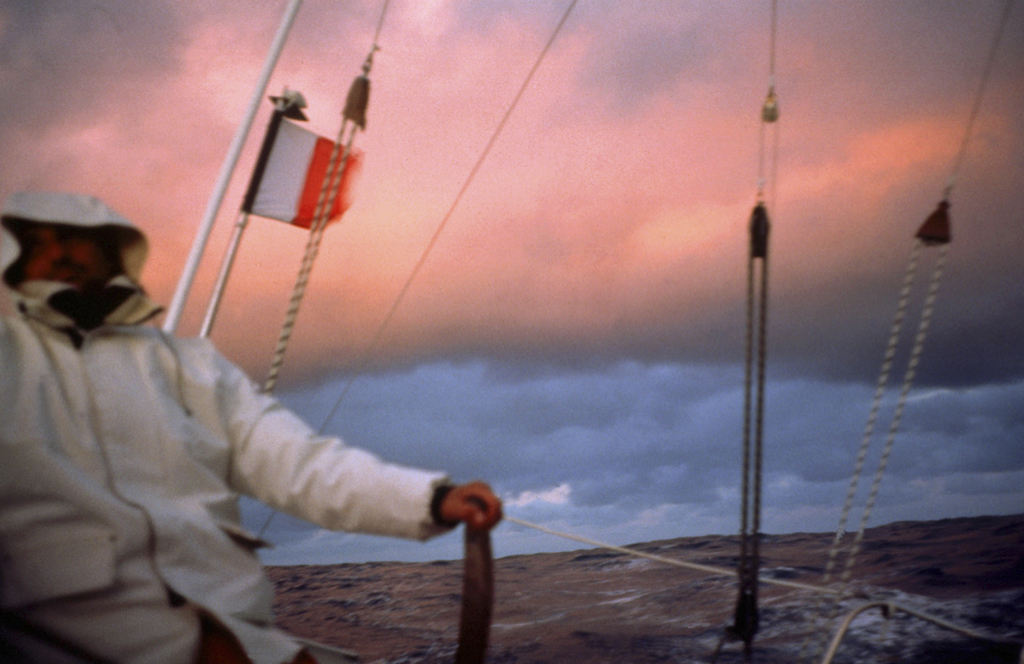
This collection of photographs documents aspects of maritime life from the South Pacific in the 20th century. Two are of scenes from the Sydney - Hobart race along the east coast of Australia to Tasmania. A third is of a shark that has been harvested from the sea.
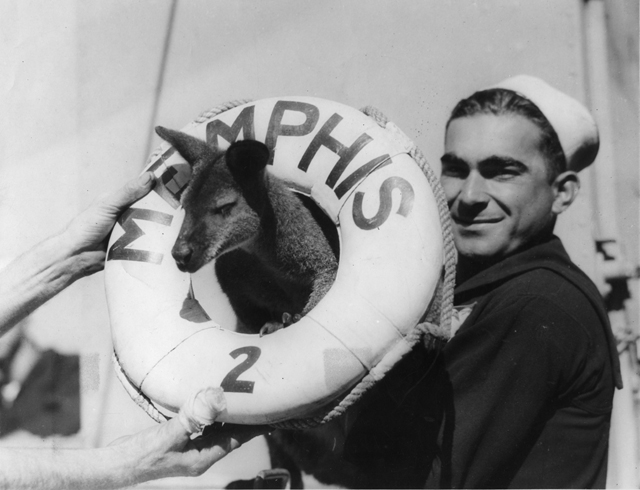
LABEL ON VERSO: TASSIE THE KANGAROO MASCOT OF THE USS MEMPHIS WAS PRESENTED TO THE CREW OF THE VESSEL BY THE PEOPLE OF HOBART, TASMANIA WITH ELABORATE CEREMOINES SPONSORED BY THE L;ORD MAYOR OF HOBART. LIKE LINDBERG TASSIE IS A TEETOTALER HIS STRONGEST JUICY BEING CARROT JUICE/
Sailor holding up life ring. The kangaroo head is poking its head out of the center.
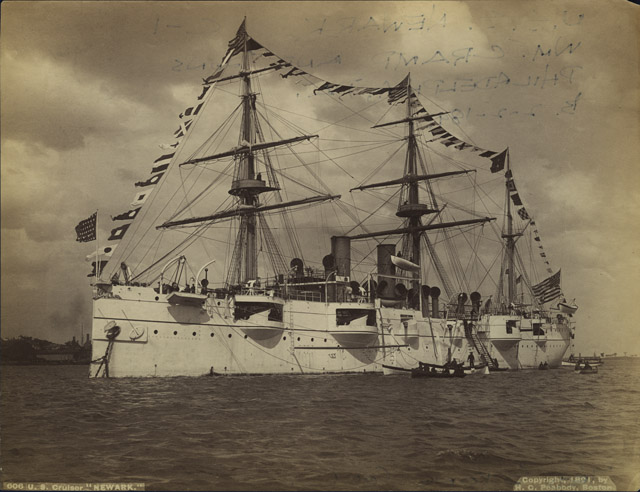
U.S.S. NEWARK C-1 WM. CRAMP AND SONS PHILADELPHIA, PA. B. 2-2-1891 TED STONE COLL. NEG 9-94 Written on front: 606 U.S. CRUISER "NEWARK." Copyright, 1891, by H.C. Peabody, Boston.
Ship underway, dressed with many banners of nautical themed flags and American flags (approximately 67 flags). Rowboats and people present on deck.
Memorial of Thomas Powell, Esq. : - who died at his residence in Newburgh, on Monday, May 12, 1856, in the eighty-eighth year of his age - by Rev. R.B. Van Kleeck, D.D
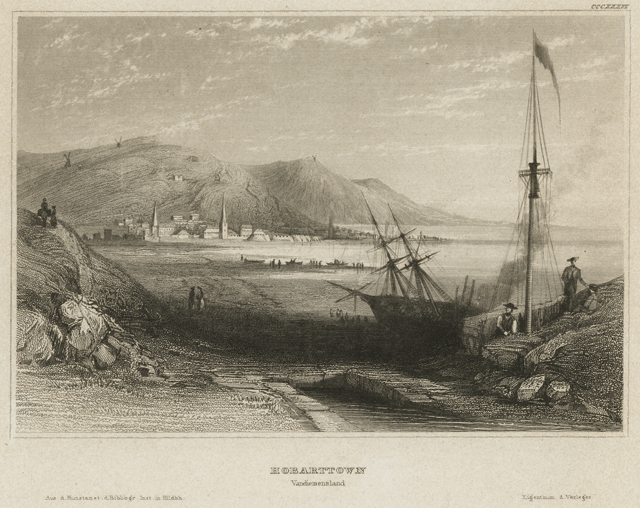
HILDBURGHAUSEN - GERMANY - Publisher; TASMANIA, HOBART - AUSTRALIA - Related Place
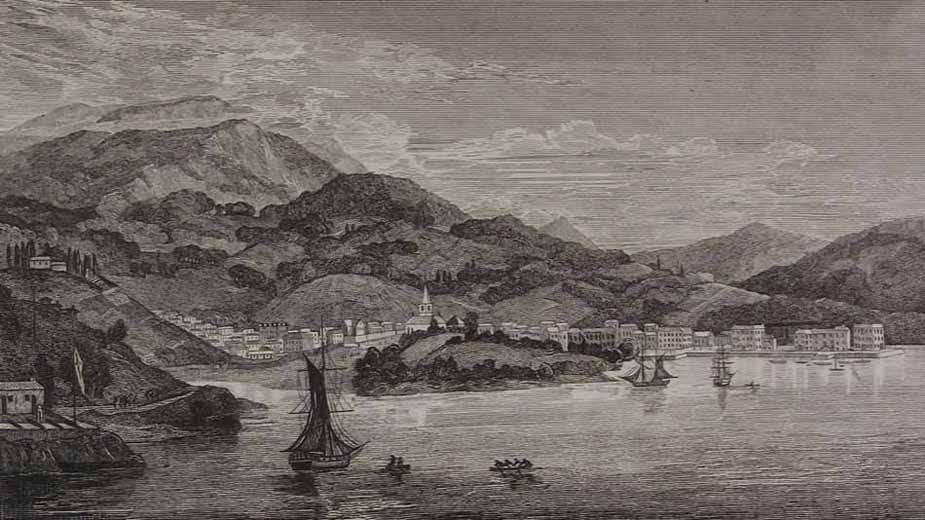
SHORT DESCRIPTION: A view of Hobart, Tasmania, an island off the southeastern coast of Australia. In the foreground on the right there is a signal pole with a pennant flag at the top, part of the network of signals. There are three people sitting and standing on the ground around it. Just behind and to the left of that is a ship with two masts that has possibly been hove down for careening, as there is smoke rising from near the stern where the workers may be removing the barnacles and sea grass (breaming) so they can insert new caulking. There are a few sailors on the crosstrees of the mizzen mast. There are several people on the ground around the ship, and there are more people with three small boats on the shore in the distance. On the left side of the foreground there are two people on the shore, and two other people on a hill, one of whom is on horseback. In the background of the image is the town of Hobart with pedimented defensive walls from the British coastal defense system, and two church steeples. On the hills above the town there are small towers with spikes or poles sticking up and out, possibly additional signal towers. NOTES: Image 336 from page 20 of volume 8 of the German edition of Meyer’s Universum, published in 1841. NOTES: The original name for the island was Van Diemen’s Land, until 1856 when it became Tasmania. NOTES: The signal stations that are visible in this print are part of a network that ran 60 miles from Hobart through Mount Nelson, Mount Augustus, Mount Communication, Wedge Bay, Mount Arthur, and then to Port Arthur. These signals were used to communicate with Port Arthur about prisoner escapes from either of the penal colonies. Signals could be passed across the 60 mile distance in approximately 15 minutes, which was part of what made escape from Port Arthur so difficult. NOTES: Aus der Kunstanstalt der Bibliographisches Institut in Hildburghausen, Eigenthum der Verleger roughly translates to From the Art Institute of the Bibliographisches Institut in Hildburghausen, Property of the publishers. Joseph Meyer (1796-1856) began Bibliographisches Institut in 1826 in the German city of Gotha. They published books in serials, which became very popular. By 1828 the company moved to Hildburghausen, where they stayed until 1874 when they moved to Leipzig. Some of the company’s books included the Meyer’s Konversations Lexicon, bibles, and Meyer’s Universum. The Universum was published in 21 volumes from 1833 through 1861, with 30,000 subscriptions in multiple languages. In 1848 Meyer sent his son, Herrmann J. Meyer (1826-1909), to the United States to establish a branch of the company here. Herrmann published the Universum (in German) in America in 1851 with added images from the US, but that quickly failed due to a limited audience that could read the language. He then hired Charles Dana to publish The United States Illustrated (two volumes covering the eastern and western US) in 1853, using many of the same engravings from the Universum. Meyer also borrowed heavily from earlier engravings by other artists, including Karl Bodmer and William Henry Bartlett, though without giving credit to them. He even created a print from a daguerreotype (see Jefferson City, Missouri, LE 2629). Herrmann returned to Germany in 1854, where he published the later editions of the German Universum to include the prints of America that appeared in the American Universum and in The United States Illustrated. Herrmann hired D. Appleton and Company of New York to publish an abridged version of the two volume The United States Illustrated in 1855, this time titled The Scenery of the United States Illustrated in a Series of Forty Engravings. The company’s buildings were mostly destroyed during WWII, but the company survived and exists today as Bibliographisches Institut & FA Brockhaus AG. The various names of Meyer’s Universum include: Meyer’s Universum, oder Abbildung und Beschreibung des Sehenswerthesten und Merkwürdigsten der Natur und Kunst auf der ganzen Erde Meyer's Universum: ein Volksbuch, enthaltend Abbildung und Beschreibung des Sehenswerthesten und Merkwürdigsten in Natur und Kunst; Octavausgabe Meyer's Universum: ein Jahrbuch für Freunde der Natur und Kunst; mit Abbildungen der interessantesten Stätten der Erde und Beschreibungen; Prachtausgabe Meyer’s Universum: ein belehrendes Bilderwerk für alle Stände NOTES: Breaming the hull means cleaning a ship’s bottom by burning off the grass, seaweed and shells that have accumulated on the hull. According to Admiral W. H. Smith’s ‘The Sailor’s Word Book’ it is performed by holding burning small bundles of wood to the bottom which causes the pitch that covers the bottom to melt which loosens the material that has adhered to the planks. Once removed the bottom is re-covered with “a composition of Sulphur, tallow, &c, which not only makes it smooth and slippery…but also poisons and destroys those worms which eat through the planks in the course of a voyage. This operation may be performed either by laying the ship aground after the tide has ebbed…or by docking or careening.”
L7166 - Officers of 9685-F - K Co. 4-1-44 Official Photograph, U. S. Army Signal Corps, HRPE, Newport News, Va. "SECRET Authority WD Cir 346 October 15, 1942 Initials WCS Date 10 APR 1944" stamped in red ink.
Embarkation (Military science).
Several officers pose together on the deck of an unidentified ship.
"This book and the Hobart exhibition of the Antarctic work of John Caldwell, Bea Maddockand Jan Senbergs are the result of a cooperative effort between the Antarctic Division (Departmentof the Arts, Sport, the Environment, Tourism and Territories) and the Tasmanian Museum and ArtGallery, Hobart." T.p. verso.
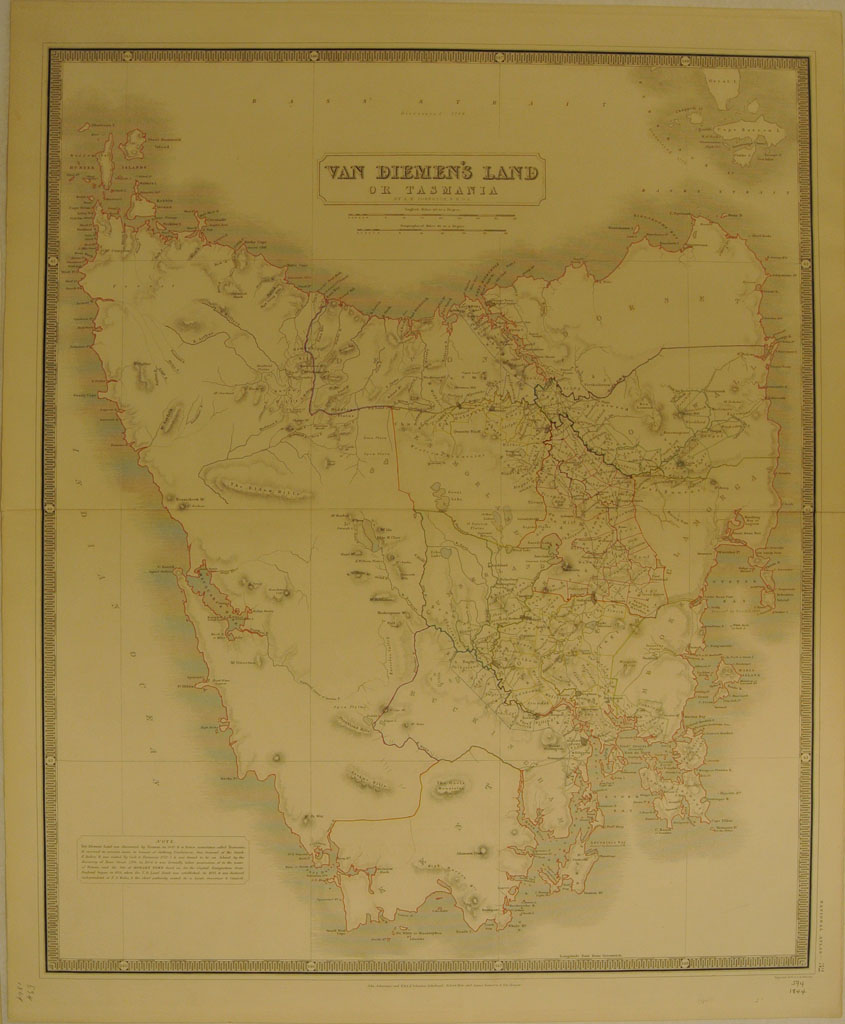
Scale is in English and geographical miles. There is a historical note on the island's discovery and settlement. States and counties are outlined in color. Very fine detail with the map engraved to show the divisions, namely Kent, Buckingham, Devon, Dorset, Cornwall, Glamorga, Cumberland, Monmouth, etc. A large unsettled region is unnamed in the west. This area will eventually be organized as Wellington, Russell, Lincoln, Montagu, Franklin, Montgomery, and Arthur. Locates the towns of Hobart, George Town, Oatlands, Richmond and Bothwell Grantham. Includes scores of small villages and settlements, all connected by a network of wagon roads. The core of settlement is limited to the central portions. The Penal Colony in Port Arthur is not noted. The scale of 10 miles per inch provides remarkable detail of the topography, watershed and coastline.
Wonderful escapes! : - containing the narrative of the shipwreck of the Antelope packet,the loss of the Lady Hobart packet, on an island of ice, the shipwreck of the Hercules, on the coastof Africa, an extraordinary escape from the effects of a storm, in a journey over the frozen sea, inNorth America
World War, 1939-1945–Military intelligence.; Intelligence service–Japan; World War, 1939-1945–Cryptography.
Intelligence and cryptanalytic activities of the Japanese during World War II : - SRH 254, the Japanese intelligence system, MIS/WDGS - by J.W. Bennett, W.A. Hobart, J.B. Spitzer
"The subject matter has been based, to a large extent, on lectures delivered to two consecutive classes of cadets at the Ensign school at Harvard university" Foreword.
New York (State)–Commerce–Canada; Canada–Commerce–New York (State).; Saint Lawrence River; Atlantic Coast (U.S.)–Description and travel.
New York colonial tracts ; no. 1
"The Journal was found in the chest of John Maher, the mate by whom it was probably written" p. ix. Head and tail pieces. Obituary notice slip inserted: p. xvii.
Publisher's advertisement on last page. Bound in mottled calf with "Society for Promoting Christian Knowledge" blind-stamped on front cover. Narrative of the loss of His Majesty's packet Lady Hobart, on an island of ice, June 28,1803 / Captain Fellowes A narrative of the loss of the honourable East India Company's shipCabalva, which was wrecked on the morning of July 7, 1818, upon the Cargados Garragos reef, in theIndian Ocean / C. W. Fracken A narrative of the loss of the Centaur man-of-war, 1782 / CaptainInglefield A narrative of the loss of the Litchfield man-of-war, on the coast of Africa, November29, 1758 / Lieutenant Sutherland.
VETERANS RECEIVE COMBAT INFANTRYMAN'S BADGE - Pvt. Chester R. Skovenski; 32942465, of the PW Guard Det receives the Combat Infantryman's Badge at retreat ceremonies at Camp Headquarters, September 14. He hails from Pittsburgh, Pa. Lt. Col. Ralph E. MacLeod, 0128748, CPH Executive Officer, from Randolph, Mass. makes the presentation as Pfc Vernon W. Klemm, 35170419, (right) of Company B, Hobart, Indiana, waits for his badge. Capt. Douglas P. Bartlett, 01322197, Director of Training from Roslindale, Mass. looks on.
Military decorations–Virginia–Newport News.; Military ceremonies, honors and salutes–Virginia–Newport News.
Shows a small group of men standing at attention, their officer is shown pinning a badge on one man's uniform while another waits his turn.
Shipwrecks and disasters at sea : - narratives of the most remarkable wrecks, conflagrations, mutinies, & etc. : comprising "The loss of the Wager," "Mutiny of the Bounty," and several others
United States–History–Civil War, 1861-1865–Personal narratives.
This collection consists of articles, business records, correspondence, notes, legal records, military papers, and pamphlets of Isaac Newton and the Newton family. The majority of the records within this collection consist of Newton's military and personal papers. Newton corresponded frequently with the Monitor's designer, John Ericsson, as well as other familiar military figures: Admiral David D. Porter, General George McClellan and Chief Engineer Alban Stimers. This collection contains not only the informative war-time correspondence and military orders of Isaac Newton, but insights into his life after his resignation from the war, as well as his family history.
81 KINGS ROAD - BRIGHTON - ENGLAND - Publisher; LONDON - ENGLAND - Publisher
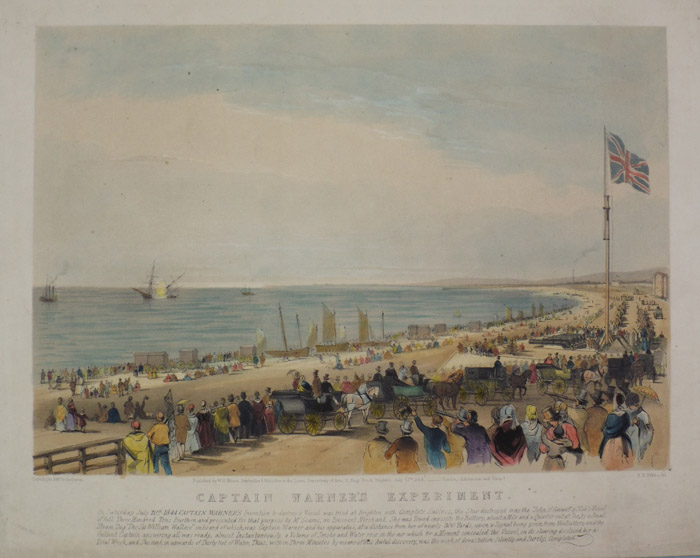
NOTES: Article from: The Courier, Hobart, Tasmainia, November 26, 1844, Page 4 CAPTAIN WARNER'S EXPERIMENT OFF BRIGHTON. The experiment illustrative of the powers of Captain Warner's invention was exhibited between 5 and 6 o'clock on Saturday, July 28. The proposition which Captain Warner undertook to illustrate by the exhibition of this experiment was, that no ship could chase a vessel furnished with his implements of warfare without herself being certainly destroyed. Whether these weapons were of a projectile or any other specific nature was not announced, so far as we could ascertain, by Captain Warner, though abundant were the conjectures hazarded upon the subject. The fact to be proved was what we have above stated, but the mode of effecting that fact was kept a profound secret. On the morning of Saturday crowds of visitors from all parts of the county of Sussex flocked into Brighton, and the first railway train brought down upwards of 500 passengers from London, a majority of whom were attracted to Brighton solely by a curiosity to witness the proposed exhibition of Captain Warner's much discussed, but much-doubted, powers. The experiment was originally appointed for Saturday, the 13th instant, but a gale of wind drove back the vessel to be operated upon on her passage from London to Brighton. This delay, however, seems to have sharpened rather than destroyed curiosity, for the visitors on this second were much more numerous than on the former occasion. We think there must have" been from 30,000 to 40,000 spectators congregated to witness the scene. The ship to be operated upon was a stout bark of 300 tons measurement, but capable of carrying 450. She was a perfectly seaworthy ship, and generously presented to Captain Warner by Mr. Somes, the eminent shipowner, for the purpose of testing the powers of his alleged destructive invention. The Government had declined going to the expense estimated by Captain Warner as necessary for the exhibition of his powers, but Mr. Somes was determined at his own cost to put an end, so far as he could, to the doubts whether the inventions in question were or were not of public importance. On Wednesday the "John o'Gaunt" was towed past Brighton by the .'Sir William Wallace," a steam-tug of 100-horse power, and came to an anchor in Shoreham Roads to await her coming fate. On our arrival in Brighton on Saturday morning, we were informed that the experiment would come off between 2 and 3 o'clock in the afternoon, but on making subsequent inquiries at Captain Warner's Hotel, where we received most polite attention from Captain W. H. Henderson, R.N., C.B., Captain Dickeson, R.N., and Lord Viscount Ingestre, we were apprised that the intended trial was postponed until between 4 and 5 o'clock, for the purpose of giving time for the attendance of Lord Haddington and Mr. Sidney Herbert, who had expressed a wish to be present. Shortly before 4 o'clock we repaired to the platform of the battery, from the signal staff of which we had learned that a flag was to be hoisted by the command of Lord Ingestre and Captains Dickeson and Henderson, to indicate to Captain Warner when the ship, the subject of his operations, was to be destroyed. The reason of this arrangement was to remove any doubt at to the bona fide nature of Captain Warner's power of destroying a pursuing vessel without having any communication with that, vessel at the moment of her destruction. When we arrived at the battery we found it occupied by a very numerous assemblage of noblemen and gentlemen, those of the naval and military professions being in a large majority. At this we cannot wonder, for if Captain Warner can effect a tithe of what he and his supporters profess, the revolution which the adoption of his projects would effect in both our sea and land services would be great indeed. The company, who generally expected the experiment to come of at 4 o'clock, waited very good-humouredly, and without evincing any tokens of impatience, until 5, when Lord Brougham, who had been manifestly chafing for some time, gave loud utterance to his expressions of displeasure and distrust of Captain Warner's intention to perform an experiment at all. In vain several of Captain Warner's friends reminded the noble and learned lord of the many impediments which prevented a short-handed crew from getting a ship under weigh with the despatch of a man-of-war's complement of hands. Lord Brougham looked through his telescope, and commented upon the tardy movements of the "John o' Gaunt's" crew in a manner which intimated that if he himself had been on board, matters would have gone on much more smoothly and swiftly. His learned and mercurial lordship lying prone upon the battery parapet, with a huge telescope resting upon his white hat, was not one of the least lenitives of the tedium of delay. At last, about a quarter to 5 the "John o' Gaunt" began visibly to move towards the destined spot of operations, abreast the battery. She was towed by the " Sir William Wallace," and attended by a small Shoreham steam-tug, the "Tees," to take off the crew of the " John o' Gaunt" previous to her destruction, and to render other services. When the "John o' Gaunt" came abreast the battery, being at a distance of about a mile and a half from shore, a Union-jack, the signal agreed upon, was hoisted on the flag-staff, to intimate to Captain Warner that he was now to destroy the ship in the wake of the "Sir William Wallace," on board of which he himself was with his implements of destruction. A short delay took place, and the Union-jack on the steamer's mast, which it was arranged should be hauled down previous to the destruction of the pursuing ship, was re-hoisted half-mast high, to indicate, as we understood, that some obstacle was in Captain Warner's way. We have been since informed that a cutter kept hovering in the " John o'Gaunt's" track, in a direction very dangerous to herself, and this prevented Captain Warner's immediate operation. At last the Union-jack was fairly lowered, the steamer's head was turned somewhat towards the shore, and the devoted " John o'Gaunt" followed in her wake. We may say without exaggeration, that the suspense of all present was painful, the silence was deep and unbroken. A smoke seemed suddenly to envelope the "John o'Gaunt," her mainmast shot up perpendicular from her deck, no noise save that of the rending of timbers was heard, and on the apparent smoke's clearing away, the smitten ship heeled over to port and sank. We say apparent smoke, because we have since ascertained that what we, and a majority of those present, apprehended to be smoke, was in reality displaced water sent up in a huge column into the air. A similar phenomenon was reported to have been exhibited in an experiment performed by Captain Warner before Sir Robert Peel, Sir George Murray, Sir Henry Hardinge, and others, in the year 1842. When the "John o'Gaunt" heeled over on her larboard side, we saw through a powerful telescope, and Captain Dickeson stated to us that he saw the same, through the main hatchway, the sea on the starboard side-a plain proof that the ship's starboard biIge was carried away. The decks, however, were not blown up, but remained entire when the ship sank-a clear proof that the force, whatever it was, and from whatever quarter it proceeded, was external, and not from within the cavity of the ship. We notice this as a fact from which important conclusions may be drawn ; but we will not imitate the example of many around us in this scene of excitement, and hazard conjectures of our own. To this fact we can bear testimony-the swift, and sudden, and complete destruction of the ship ; and we are authorised by Lord Ingestre and Captains Dickeson and Henderson to give their decided opinion, founded upon an examination of the vessel and the facts displayed in the course of the experiment, that the cause of destruction was exterior, and not intrinsic. The applicability of this terrific power to purposes of actual warfare must be tested by the competent and constituted authorities, but of its existence in the possession of an individual there is now such evidence that an omission on the part of Government to sift this matter thoroughly would be culpable in a high degree. We understand that since the accession of Sir Robert Peel to power various negotiations have been instituted between Captain Warner and the Government, all which have gone off or been suspended, on the ground that his experiment was too costly. We are always advocates of economy of the public money, but parsimony is sometimes the worst of economy, and whatever affects the maritime supremacy of Great Britain it of such stupendous importance, that no pecuniary consideration of an ordinary amount ought to stand in the way of a proper investigation of any matter affecting that supremacy.
 Full-size image
 lp4541
 fn309
 Full-size image
 lp4556
 1946.1027.000001
 1951.0492.0000021
 Full-size image
 PN13050STN-Newark
 1936.0603.000001
 P0003-01 - L-7166
 MSM1254
 lp186
 KIC Image 3
 P0003-01 - E-15802
 lp4454